

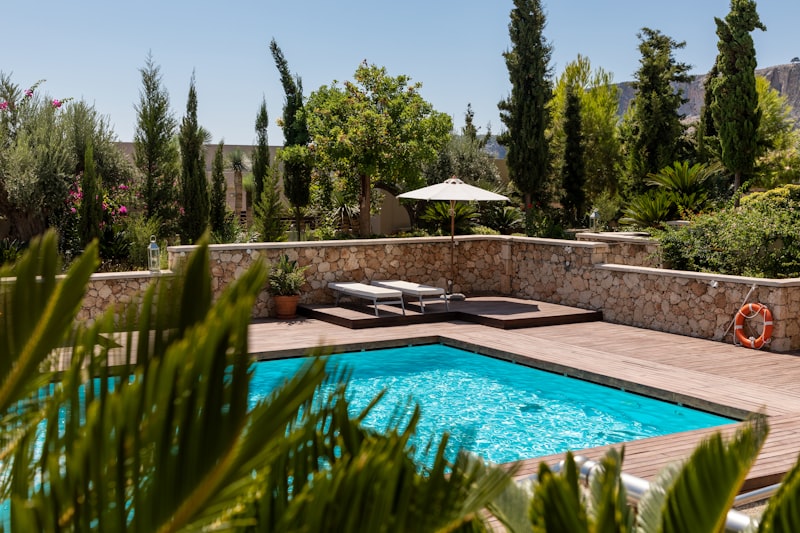
Most people call a renovation contractor because something has broken — a crack, a leak, a pump that died in July, a plaster that finally gave up after fifteen summers. That's a fine reason to start. It's also a narrow one. If all you fix is the thing that broke, you end up with the same pool, minus the failure. The lot, the lighting, the layout, the way the water moves — all still what they were in 1994.
A renovation is the rare moment when everything is open at once. It's worth using.
Start with the question, not the pool
Before anyone measures a bond beam, it's worth sitting in the backyard at 6pm on a Saturday and asking: what do we actually want out of this space? Are we swimming? Entertaining? Watching kids? Having a drink at sunset while the pool glows under the house? The answer changes the entire renovation.
A pool designed for afternoon swimming has shallow depth and wide tanning ledges. A pool designed for evening conversation has raised walls, spillovers, and lighting that turns the water into a lantern. Same shell, completely different outcome. If you commit to the bid before you answer that question, you're going to pay for a pool that doesn't match what you actually wanted.
Understand what renovation can't fix
A renovation can change a lot — finish, tile, coping, equipment, lighting, water features, even the shape of the shell within the existing footprint. What it can't always change is where the pool sits on the lot. If the fundamental problem is location — too close to the house, wrong orientation to the sun, awkward proximity to the street — that may be a teardown and relocate, not a renovation.
The most expensive renovation is the one that doesn't solve the real problem.
A good contractor will tell you that honestly at the site visit. If the footprint is right and the shell is sound, renovation is almost always the better answer — faster, cheaper, and you keep the existing permits.
Equipment: the part you can't see
The equipment pad is the most-overlooked piece of a renovation. It's also the piece that most affects how your pool behaves day to day. Florida summers mean long pump run-hours. A variable-speed pump saves real money against a single-speed one. LED lighting transforms how the pool reads at night. Salt systems reduce the maintenance burden. Automation makes the whole pool addressable from your phone.
None of this is visible when the shell is finished. All of it matters for ten years.
A short, honest list:
- Variable-speed pumps — lower energy bills, quieter operation.
- LED pool lights — transform evening use; last roughly ten times as long as old halogens.
- Salt systems — less chlorine handling; gentler on skin.
- Automation — pumps, lights, heater, spa on a schedule and on your phone.
- Heat pumps — extend the Florida swim season without a gas line.
The finishes tell the whole story
The two most-visible elements of a renovation are waterline tile and plaster. Both get chosen, by most contractors, from a laminated binder of about twelve options. Don't settle for that. The tile around the waterline is at eye level when you're in the water. The plaster is the surface you see every time you look at the pool.
Pick tile that responds to the house — glass for modern, porcelain for something more restrained, stone for a certain kind of warmth. Pick plaster with the right aggregate for the look you want, not just the cheapest grey. These are the differences between a renovated pool and a pool that looks like someone just patched it.
Plan for the deck before you sign
The single thing that distinguishes a remodeled pool from a renovated backyard is the deck. A new shell with an old deck will always look like a new shell with an old deck. If the deck is cracked or dated, budget for replacement in the same project — travertine, stone, or quality concrete, not textured pool decking that dies in three summers.
While the deck is open is also the right time to think about lighting, landscaping, and transitions to the house. Those are the details that make the renovation feel complete.
What a good renovation process looks like
Before you sign: a site visit. Photos, measurements, a conversation about use. Then drawings. Not a bid — drawings. Plan view, elevation, material samples, lighting scheme. Revisions until it's right on paper. Then a written scope with line-item pricing. Then permits, engineering, HOA. Then build.
If anyone tries to give you a price without a drawing first, that's worth paying attention to. The price they quote is for a pool they haven't thought about yet.
The right first call
The first conversation you have with a contractor tells you more than any bid will. Ask them what they think before they talk about cost. Ask what they'd do differently if it were their backyard. Ask them the last renovation they turned down. The answers tell you whether they're going to design for you — or sell you.
When that conversation goes well, the rest of the project tends to as well. That's the part we care about most.
Thinking about a renovation in Maitland, Winter Park, Orlando, or anywhere in Central Florida? We'll walk your backyard and talk it through honestly. Request a site visit →